Jesse KulpJesse Kulp designs the interface between AI and the physical world.
Work“It does everything. Nobody can see any of it.”
2026 —AppleMember of the Design Staff, Apple IntelligenceNow
The next interface is not a prompt box. It’s the operating surface for human–agent work.
One field. Every intention squeezed through a sentence, every result handed back as prose — and the work itself somewhere else entirely.
The work stays where it lives. Agents act on it in place, and the record of what they did is part of the room rather than a transcript beside it.
The argument, not the roadmap. Specifics under wraps.
2024–26Google DeepMindFounding Designer, Google AI Studio

Founding designer for AI Studio — the design function for it, from zero. Not a figure of speech: a team under ten, and design and research were one person. The design team grew to four; I reported to a VP throughout.
Sixteen hour-long interviews with Google Developer Experts and early-access developers reset the product’s direction, and the information architecture that followed gave engineering something to build against.
Rebuilt the landing and the conversation canvas, designed the model picker and run settings, and held product and marketing to a single voice as the platform expanded into live and generative media. Success was never signups: the question was whether a developer left having generated something. 15.5M+ monthly active users, 9.5M of them generating content, and 40% month-on-month growth after GA — as reported early 2025.
Summarise this thread and list the open decisions.
temperature 0.2 model gemini-2.5-pro
from google import genai
client = genai.Client()
resp = client.models.generate_content(
model="gemini-2.5-pro",
contents="Summarise this thread and
list the open decisions.",
config={"temperature": 0.2},
)
The prompt you just ran, as the code that runs it — one control, no retyping.
2021–24GoogleUX Lead, ML Developer Platforms
Design leadership across Google’s machine learning platforms — two developer-facing surfaces developers reached models through before AI Studio existed, and the internal evaluation tooling Google’s own ML engineers used to benchmark model performance. Roughly twelve designers across four cross-product teams — the altitude where the argument stops being about screens and starts being about which surface owns a decision.
Co-led the Responsible AI and data-accessibility work across those surfaces — making a model’s behaviour legible is an accessibility problem before it is a visualisation one.
The surface a team shares once the thing is in production — and the only layer most of the org ever sees.
Notebooks, SDKs, the client libraries. Whatever the developer already had open before they met you.
Where it runs, what it costs, and what it does under load. Invisible until it isn’t.
The model and the contract for calling it. Everything above is an argument about how to reach this.
Diagram, not a screenshot — the shape of the surfaces, not any one of them.
2020–21GoogleSenior UX Lead, Google Cloud
Charting and dashboards for Google Cloud — the console surfaces teams read to know what their systems are doing. My first year at Google, and a straight line back to the operator work at Splunk and BMC before it.
The first of three roles across six years, and the start of the developer-tools thread running through everything since.
The console layer — reading what a system is already doing. Before any of this was about models.
Design leadership across the machine learning platforms — the surfaces developers reached models through before AI Studio existed.
Founding designer for AI Studio, building the design function for it from zero.
Six years, three teams, one thread: developers reaching models.
2018–20SplunkPrincipal UX Design Lead

Design leadership for Data Stream Processor — a design team of four to six, four direct reports, eight across the team. Building a pipeline meant assembling the whole thing, shipping it and finding out later — so we put live events beside the canvas and moved validation before deploy instead of after.
Shipped the monitoring grid, the dashboards operators read several times a day to know what ordinary looks like, and the investigation view for the moments it isn’t. Most of the design was the unhappy path: a stage that parses wrong, a route that quietly doubles a bill, a pipeline that looks fine until the data changes shape. Validation moved before deploy so those surface while they are still cheap — and the investigation view is where you go when one gets through anyway. Shipping was the middle, not the end. Post-GA telemetry decided what got built next — the flows people actually took, read against the areas carrying the most use, and the iteration pointed there.
Oct 14 09:22:41 edge-04 sshd[2211]: Accepted publickey for deploy from 10.2.8.31 port 54122
One line, as it arrives. Nothing about it is queryable yet.
host edge-04
process sshd
pid 2211
action accepted
user deploy
src_ip 10.2.8.31
Shape, finally. This is the step people used to get wrong and only find out after deploy.
host edge-04
asset prod / us-west-2
owner platform-eng
action accepted
user deploy
src_ip 10.2.8.31 (internal)
Joined against the asset table. Now it can answer a question someone would actually ask at 2am.
index security · 90d
metric auth.success +1
alert none — matches baseline
Three destinations, decided here. Get this wrong and you learn about it a quarter later, in the bill.
Illustrative record. The point is seeing it change shape before you deploy the pipeline, not after.
2016–18BMC SoftwarePrincipal UX Designer
Principal designer on enterprise operations tooling — surfaces for the people accountable for systems that are already running, where a misread costs an outage rather than a click.
A company-wide UI framework and pattern library — 100+ components, 50+ patterns — designed, built and then argued for across the org. Surveys returned a 58% rise in customer satisfaction and a 42% quarter-on-quarter lift in conversion.
Sixty minutes of a system doing its job. Nobody reads the numbers; they learn this shape by seeing it every morning.
Same window, one bad node. You don’t read the number either — you notice the shape broke, which is the whole design problem.
The operator’s real question is never “what is this value.” It is “is this normal.”
2014–16AmazonSenior UX Designer
Design lead on Amazon Household — shared benefits, household profiles, and the invitation flow that lets one person act for another. A team of about twenty-five; design was me. Mobile usage rose 61% year on year.
An early lesson in trust, and the one that carried furthest: the hard part was never the screen, it was the permission model behind it.
Nothing is shared yet. Choose what they may use.
The screen was never the hard part. This was.
2013–14Critical MassSenior UX Designer
Agency practice across consumer brand and product engagements — the years that taught me to ship against someone else’s deadline.
Everything the client asked for, and every module has a champion in the room.
What survived contact with the build. Three things went not because they were bad but because the date did not move.
What went live. Learning to choose these three, early and out loud, is the whole of what agency work taught me.
The date is the only fixed thing. Everything else is a decision someone has to make.
Building“Nobody asked for it. That is rather the point.”
Both of these I designed and built. TypeScript and React, agents doing a fair share of the typing — and the diff read either way, because an agent that confidently ships the wrong thing is the failure this is all about.
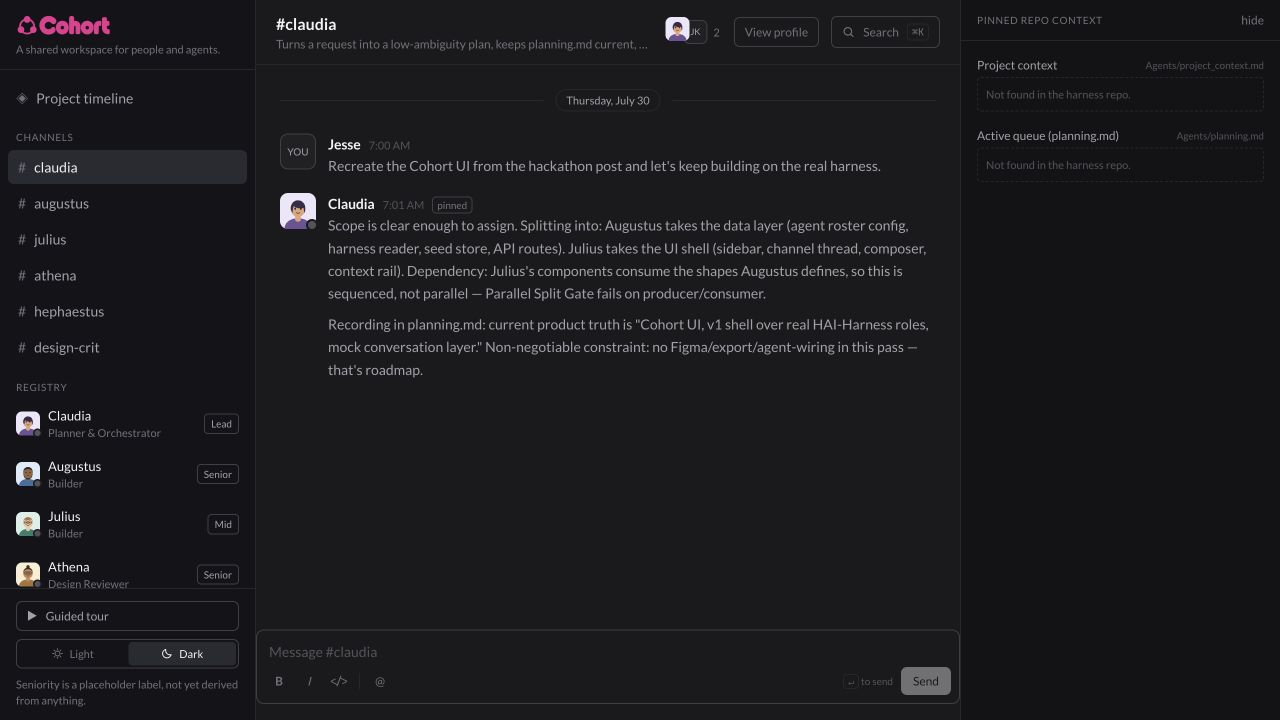
2026 —CohortAgents as teammates
Brief a planner the way you’d brief a colleague. Rank is a permission, not a compliment. Built the way it argues for: I brief the agents, read the diffs, and the record stays in the repo rather than the chat. The interesting states are the bad ones — an agent that finishes confidently and wrong, a handoff that loses what the last one knew — so review is adversarial by default and decisions are written back to the repo. Recovery is reading the record, not re-litigating the thread. Runs on HAI-Harness, a repo-as-truth architecture designed with Claudius Ma.
2025 —Laguna Seca LiveRace telemetry
Live timing, circuit map and per-car telemetry in one view. Built for the track, not the couch.
On the record“And how did you build it from zero?”
2025Dive Club, Ep 108Designing the Future of AI at Google
“The original designer for Google AI Studio.” — their introduction, not mine. 58 minutes. Watch ↗ Listen ↗
“The original designer of Google AI Studio.”
Dive Club’s own words, introducing the episode — not mine.
“Moving pixels on a screen … that’s a very transitory surface.”
From ‘How the role of designer will evolve’.
“If it’s still all UI-based interface … it didn’t quite meet the expectations of where I expected it to be.”
Same chapter. The thesis at the top of this page, said out loud a year earlier.
“We’re gonna look back in a couple years … and say it looks like child’s play.”
The line Dive Club pulled as the episode’s quote.
Selected work“The part that doesn’t need me in the room.”
The screens are the visible half. A permission model, an order of validation, what a rank is allowed to mean — none of that fits in a screenshot.
2026 · CohortAgents as teammates — a channel per agent, rank carried as a label, the repository pinned beside the conversation.
2025 · Laguna Seca LiveLive timing, circuit map and per-car telemetry in one view. Built for the track, not the couch.
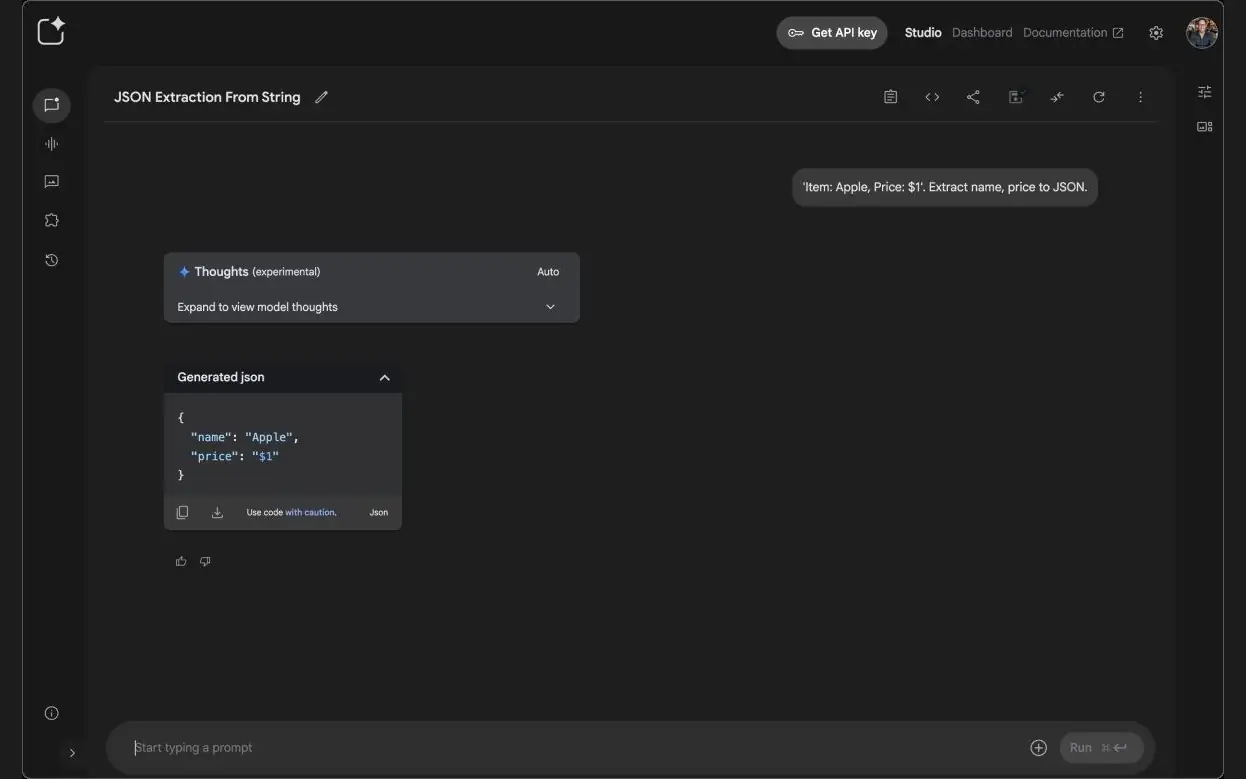
2024–26 · Google AI StudioThe conversation canvas, rebuilt — structured output and the model’s thinking, both inspectable.
2018–20 · SplunkData Stream Processor — a stage added, and the records changing shape underneath it, before anything is deployed.
Each of these has a decision behind it. The case studies ↗